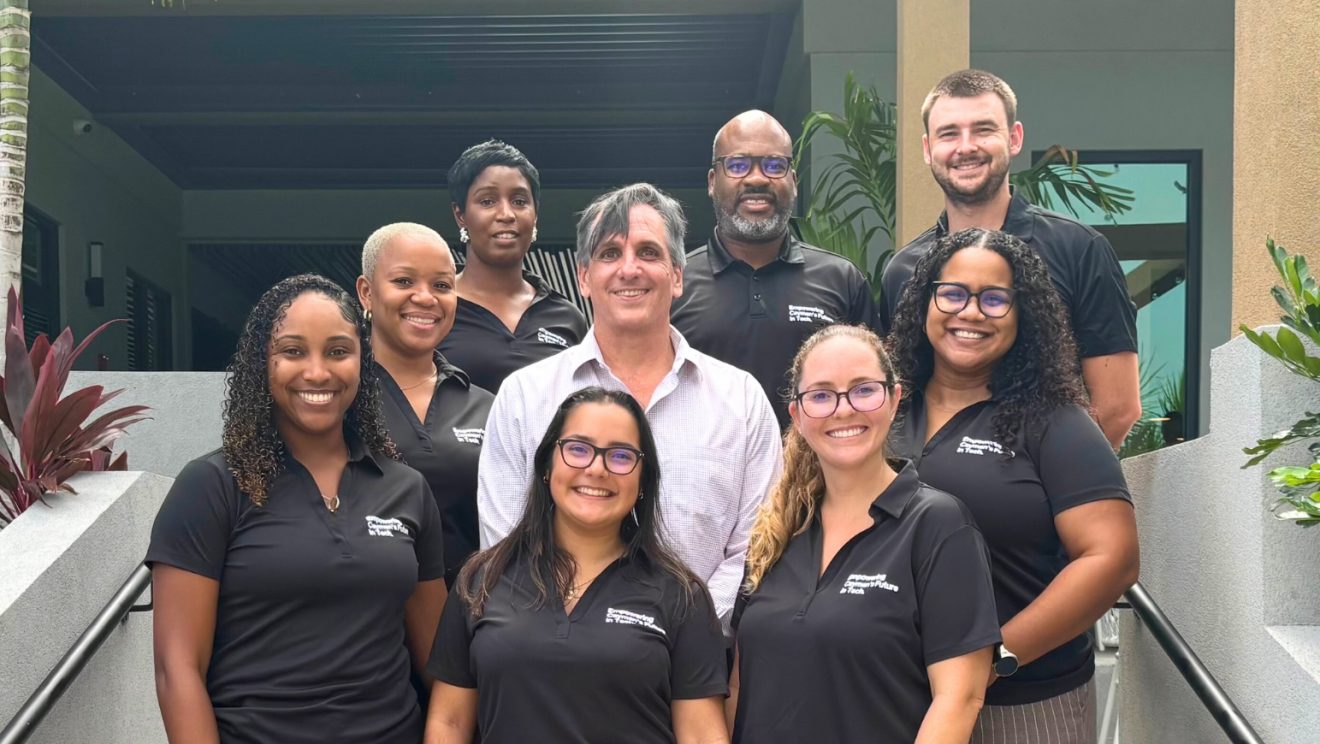
From left, Matt Ellis, a CFA Society Cayman Islands; Jonathan Shaffer, co-founder and chief executive of Fission Labs; Mike Silagadze, co-founder and chief executive of Ether.fi; and Duke Kim, director of institutional solutions at Securitize Fund Services.
Tokenised funds will only justify themselves if investors can do more with a digital fund share than with its paper equivalent, such as selling it between redemption dates or borrowing against it, panellists at the CFA’s 12th Annual Cayman Investment Forum said on Thursday.
Speaking on a panel titled “Beyond the wrapper: What tokenised assets can do once onchain”, executives from three firms working at different layers of the market (issuance, liquidity and distribution) said the industry had moved on from the hype of a decade ago. They warned, however, that repetitive investor onboarding, complex user interfaces and regulatory uncertainty were still holding back adoption.
Matt Ellis, a CFA Society Cayman Islands board member who moderated the session, described tokenisation as “probably one of the most used but least understood” terms in finance, noting that early promises to put real estate and private assets on a blockchain had evolved slowly before major institutions began tokenising their largest funds.
Unlocking gated funds
Jonathan Shaffer, co-founder and chief executive of Fission Labs and a former hedge fund investor, said tokenisation offered three things: global distribution, liquidity and leverage. “The fundamental issue today is that there still is not liquidity available for users who want to sell their positions,” he said.
He gave the example of an Apollo private credit fund that allows quarterly redemptions of up to 5% of the fund, with requests above that threshold gated and pushed into the following quarter. “In a traditional paper version, if we’re 60 days, 80 days to the next redemption cycle, you have no action. You’re stuck. You have to wait,” he said.
A tokenised share lets a liquidity provider such as Fission buy an eligible position at a discount at any point in the quarter. It is priced, he said, more like receivables financing than equity trading. “It’s worth what Apollo says. I’m just calculating what is my risk to warehouse and inventory that position for 60 days or longer before I give that back to Apollo,” he said.
With lenders typically advancing less than 70% of a position’s value, he argued, the risk was modest. “The probability that an Apollo fund goes down 30% in 60 days is effectively zero. And if that happens, you know, find a bunker.”
Duke Kim, director of institutional solutions at Securitize Fund Services, the firm that tokenised BlackRock’s USD Institutional Digital Liquidity Fund (BUIDL) money market fund and works with managers including Apollo, explained the leverage benefits of tokenisation in terms of an investor earning 10% on a tokenised private credit fund. This investor could borrow against the position and reinvest. “You loved it at 10%. You’re going to love it a lot more when you’re getting 14% with leverage,” he said.
The real value of tokenisation was not just as a distribution or fundraising tool. The aim was, Kim said, to let investors do more with their money and their investments.
“Same rights, same obligations”
Back-office savings, often promised in connection with tokenisation, had not yet arrived because the space is still nascent, he admitted.
Kim said a digital security carries the same rights, obligations and restrictions as the paper security would. “You still need audit. You still need fund administration. You still need KYC/AML. All those things have costs to them.”
Kim put the tokenised real-world asset market at just about $40 billion, but he said BlackRock’s long-term commitment had prompted a “fast follow” by other managers. He recalled one manager’s explanation: “BlackRock is so big they can afford to be early to the party, but if they’re really early to the party, it becomes their party.”
The practical work, Kim said, began with the fund’s structure. Some products, such as BUIDL, were entirely new funds: “There is no paper investor into BlackRock’s tokenised money market fund. You can only access that product digitally.” Others added a tokenised share class or feeder fund to an existing structure, giving investors a choice of a paper or a digital route in.
That made the choice of lawyers and jurisdiction an early conversation, he said, and the Cayman Islands was “just a great jurisdiction because they’ve really been at the forefront of crystallising rules around registered private funds in a tokenised capacity”. Jurisdictions that laid out clear “rules of the road”, he added, tended to gain a first-mover advantage.
“A drop-in replacement for your bank”
Mike Silagadze, co-founder and chief executive of Ether.fi, described his firm as a self-custodial “drop-in replacement for your bank” running on crypto rails, with about $5 billion in deposits and around $2 billion in annualised card transactions.
The reason users should care about crypto rails, he said, was “much higher rewards”, citing 3% cash back on card spending and loans against assets at 4%, “a lot better than what your bank will probably give you”. The model was cheaper, easier and more rewarding, he said.
A customer who bought a tokenised share of Nvidia could “just send it to somebody, and one click they have an account”, something he said would otherwise take “seven pages of KYC and probably a month of approvals” with a traditional firm.
Its users, he said, were concentrated in Latin America, Southeast Asia and Europe, with almost none in North America or the Caribbean. Someone in Brazil with $100 could convert local currency to dollars, buy shares, borrow against them and invest in a private credit fund, “probably with better pricing, better execution” than a client with $10 million in a private wealth account at a major bank.
Asked by Ellis how Ether.fi could pay depositors 4% or more when banks offered around 20 basis points, Silagadze said much of the crypto yields came from traders in the crypto space paying for leverage.
Those loans were over-collateralised and subject to well-tested liquidation mechanisms, he said, but tokenised real-world assets now offered a “much healthier” alternative source of yield.
Onboarding divides the panel
Panellists differed on whether investors could reuse KYC checks. Shaffer said repeating KYC checks for every fund made “no practical sense”, likening it to “going to a store and having to buy bread with one credit card and pull out another credit card to buy your chips”.
“I’m begging someone to please fix this. We need a KYC passporting solution,” he said. Set-up processes of 15 to 40 days were tolerable for institutions writing $10 million cheques, but investors with $50,000 or $500,000 “just don’t want to go through the friction of spending 60 days to give you their money”.
Kim, in turn, argued that KYC risks still sat with Securitize or the relevant issuer, and each asset manager applied its own bespoke rules. “Even in the real world, there is no utility KYC,” he said, adding that a shared standard would require “a seismic shift” in the asset management industry.
He illustrated the problem with a real estate manager who wanted to launch a tokenised Cayman Islands vehicle with a $100 minimum. Kim told him onboarding each investor would cost $150 to $200. “The real world still has an impact on chain,” he said.
Silagadze said the biggest constraint was regulatory clarity. A US customer could open a fintech account in 30 seconds, he said, whereas his firm had to collect a driving licence, a utility bill and a liveness check, and repeat the process as users switched on new features. “We can’t offer tokenised stocks. Why? Because it’s a grey area,” he said of the US market.
What comes next
Looking ahead, Kim said he was most excited about tokenised public equities, distinguishing between derivative products and tokens backed by actual shares. Holders of some broker-issued tokenised stocks, he said, “don’t actually own tokenised Tesla. They own counterparty risk.”
Shaffer pointed to recent SEC exemptive relief allowing ARK’s venture fund to issue a tokenised share class directly, which he said other managers had moved quickly to follow. He predicted “hundreds of options for Blackstone, Apollo and KKR, all purchasable in a single wallet, single interface”, adding: “That’s simply not a product that exists today.”