The Cayman Islands has been classified as a strong wealth preservation jurisdiction in the Henley & Partners Global Wealth Mobility Framework 2026. The analysis identified tax neutrality, political stability, capital mobility and wealth preservation infrastructure as Cayman’s core structural strengths.
The framework, introduced in this year’s Henley Private Wealth Migration Report, marks a shift away from the annual millionaire migration forecasts and country rankings of previous editions. Developed by Henley & Partners, with analytical support from AlphaGeo, it assesses jurisdictions across 12 weighted dimensions and 38 indicators, benchmarked against data from the World Bank, the IMF, the OECD and the Global Peace Index. The resulting Wealth Mobility Competitiveness Score measures the structural factors that influence a jurisdiction’s ability to attract, retain and support international wealth, rather than actual inflows or outflows.
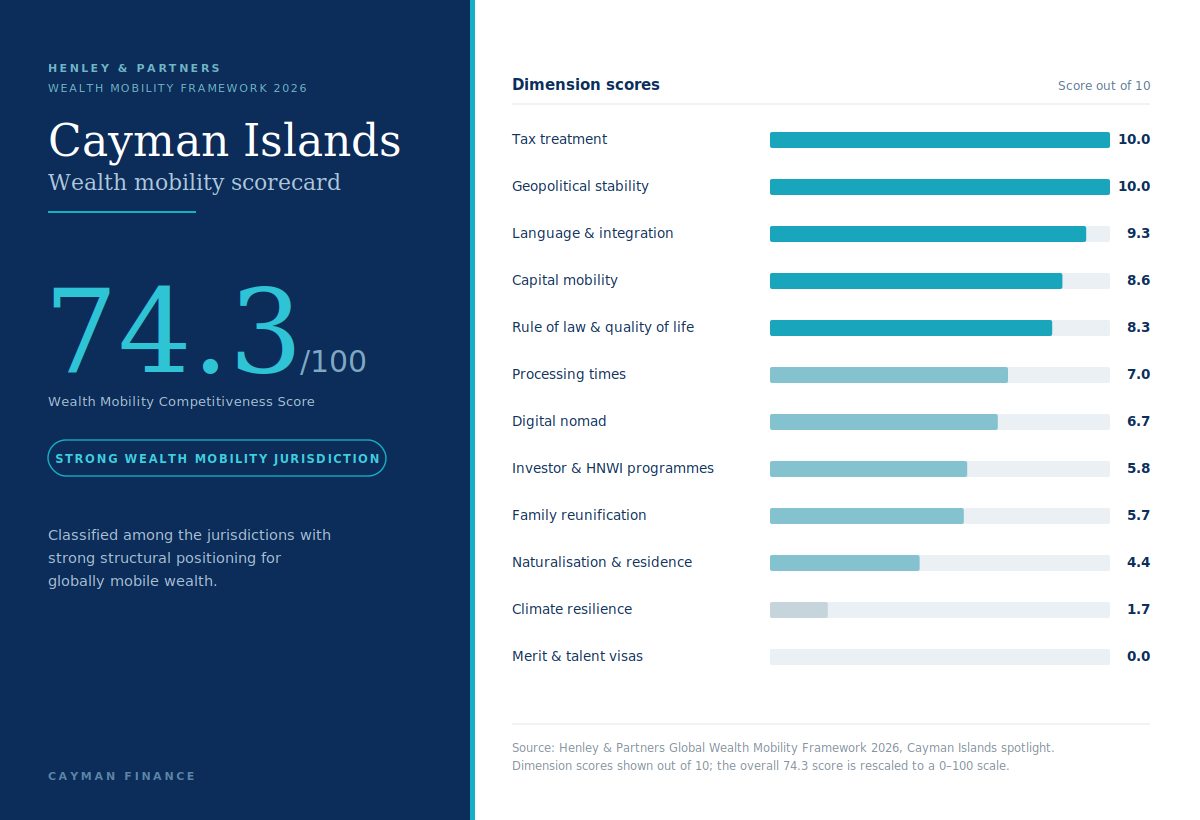
The Cayman Islands recorded a score of 74.3 out of 100, placing it among jurisdictions with strong structural positioning for globally mobile wealth. It earned the highest possible marks for tax treatment, reflecting the absence of direct taxation on income, capital gains, inheritance and corporate profits. Cayman scored equally strongly on geopolitical stability, anchored in its status as a British Overseas Territory with a UK constitutional backstop and full local fiscal autonomy. The framework also scored Cayman strongly on capital mobility, supported by an open capital account and deep fund administration infrastructure, and an English common law system with the Privy Council as its final court of appeal.
“The framework confirms Cayman’s appeal is based on its structural foundations rather than any single incentive,” said Brittany MacVicar, Associate Director for Trusts and Private Wealth at Cayman Finance. “Tax neutrality, political stability, an English common law system and experienced financial services professionals combine to make the jurisdiction a trusted base for international wealth.”
The report places Cayman within a cluster of specialist wealth-preservation jurisdictions that includes Singapore and the United Arab Emirates, describing it as a jurisdiction built to hold, structure and move capital with minimal friction. Within that cluster, the framework singles out Bermuda as the most similar to Cayman. The two share British Overseas Territory status, a financial-services-led economy and the same exposure to climate risk, yet Cayman’s score of 74.3 sits ahead of Bermuda’s 72.0, a margin the analysis attributes to the depth of Cayman’s fund sector and the strength of its capital-mobility infrastructure.
The central theme of the Henley & Partners report is that the more important question is no longer where wealth is moving, but why certain jurisdictions consistently attract and retain it, as high-net-worth families increasingly build portfolios of residence rights, citizenships and investments across several jurisdictions rather than tying themselves to a single country. Cayman’s infrastructure and financial services ecosystem have made it an increasingly popular destination for establishing family offices in recent years.
Separate research from Ocorian found that four in ten (41%) wealth management professionals globally forecast that the Cayman Islands will see the fastest family office growth of any jurisdiction over the next three years. The survey, which canvassed more than 300 family office professionals collectively responsible for US$155 billion in assets under management, placed Cayman second only to Singapore among jurisdictions most likely to benefit from increasing global wealth and ranked it as the first choice for European HNWIs seeking offshore structuring solutions.
“Families rarely tie themselves to a single country now. They spread their interests, and when they decide where to base the family office and hold their structures, they increasingly choose Cayman,” said MacVicar. “The expertise is here, the law is familiar to their advisers, and they can be confident the jurisdiction will work the same way in ten years as it does today.”
The framework identifies climate resilience as the principal structural consideration for a low-lying Caribbean jurisdiction, alongside the evolving global transparency agenda, while concluding that neither currently displaces Cayman’s core proposition.
The Henley & Partners Global Wealth Mobility Framework 2026 offers an external, data-led read on something the sector has long argued: as global wealth grows more mobile, Cayman has the qualities to attract and preserve it.