
Beneficial ownership registers in the Cayman Islands, as in most other countries, are not public documents. Access is restricted to designated competent authorities and law enforcement agencies, with one important exception: the Legitimate Interest Access (LIA) framework, introduced by the Beneficial Ownership Transparency (Legitimate Interest Access) Regulations 2024.
The Cayman Islands’ framework for legitimate interest access to beneficial ownership information has been in force since 28 Feb 2025.
The LIA Regulations permit several categories of applicants to request access from the competent authority to beneficial ownership information held on the central search platform. They are journalists, bona fide academic researchers and representatives of civil society organisations, as well as anyone seeking information in the context of a potential or actual business relationship or transaction with the legal person about whom information is sought.
In every case, the applicant must demonstrate a legitimate interest, specifically, that the information is sought for the purpose of preventing, detecting, investigating, combating or prosecuting money laundering, its predicate offences, or terrorist financing.
Journalists must also provide evidence of their credentials and a demonstrable link between the legal person and suspected financial crime. Academic researchers must show a genuine research purpose. Civil society organisations must document their AML/CTF mandate. And business counterparties must evidence the actual or prospective transaction and explain its relevance to financial crime risk.
Applications are submitted electronically through the competent authority’s portal and carry a non-refundable administrative fee: CI$75 (approximately US$91) for a single legal person, and CI$100 (approximately US$120) for an application covering multiple entities.
Processing typically takes up to fourteen business days. Information disclosed upon approval includes, for individuals, the name, country of residence, nationality, month and year of birth, and nature of control; and, for legal entities, the name, registered office, legal form, registration number, and nature of control.
Legitimate interest access statistics
For the first time, data from the Cayman Islands Registrar, the competent authority for beneficial ownership, offers concrete statistics on applications and approvals during the first 14 months.
The numbers are modest in absolute terms. As of 7 May 2026, the competent authority had received 12 applications for legitimate interest access since the LIA Regulations came into force.
The overall approval rate, excluding withdrawn and pending applications, is 70%.
The breakdown by applicant category is as follows:
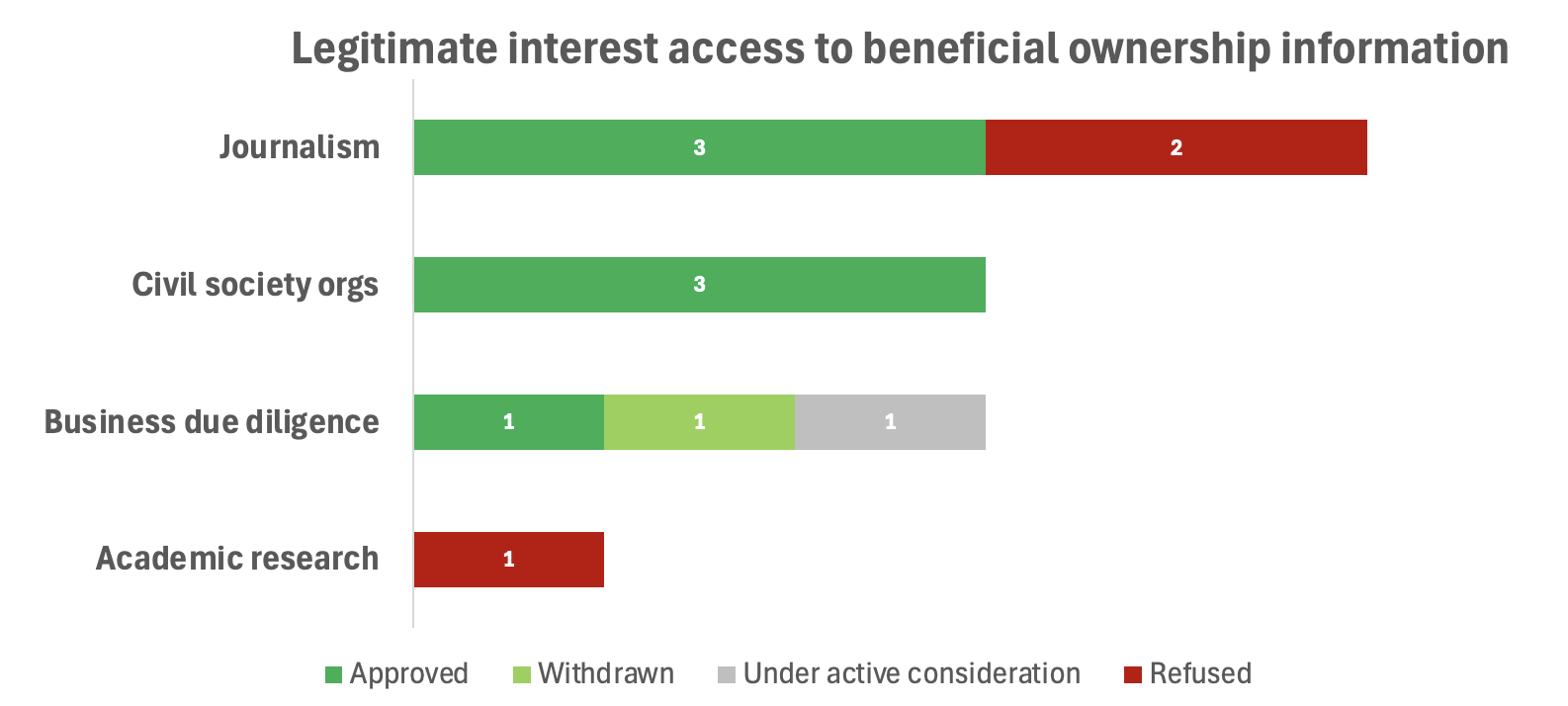
Several observations can be made regarding the figures. The first is the low absolute volume. Twelve applications over fourteen months, against a backdrop of tens of thousands of Cayman-registered entities and sustained international attention on offshore beneficial ownership transparency, suggests that demand for access to Cayman beneficial ownership information through the formal LIA mechanism is considerably more limited than critics of offshore jurisdictions sometimes imply.
Whether this reflects low awareness of the mechanism among potential applicants, a considered judgment that the evidentiary requirements are too demanding to satisfy, or simply a limited pool of genuine cases, is difficult to determine from the data alone.
The second observation concerns the journalism category. Three approvals from five applications represent a 60% approval rate, a figure that runs counter to the assumption, sometimes voiced in policy debates, that Cayman’s access framework is structurally hostile to investigative journalism.
In fact, journalists who came prepared with credentials and evidence of a documented link to suspected financial crime had their applications approved. That is the legitimate interest standard working as intended.
The third observation is the 100% approval rate for civil society organisations. All three applications from organisations engaged in AML/CTF work were approved. This is relevant to international civil society groups that may have assumed the access framework would pose an insurmountable obstacle to their work. The data suggests otherwise, at least for organisations that can demonstrate a genuine mandate and purpose.
Access restriction applications
Running alongside the LIA mechanism is a parallel framework allowing individuals to apply for protection from public disclosure. Under the Beneficial Ownership Transparency (Access Restriction) Regulations 2024, which came into force on 9 December 2024, a current or prospective registrable beneficial owner, or a senior managing official, may apply to the competent authority to prohibit the disclosure of their information to any member of the public, on the grounds that disclosure would place them or a household member at serious risk of kidnapping, extortion, violence, intimidation or similar harm.
Applications require supporting evidence, such as police reports, documented threats or equivalent, and carry a fee of CI$1,000 (US$1,200). The competent authority must issue a decision within seven business days. If approved, the restriction will have effect for three years. It may be revoked if the individual is convicted of a serious dishonesty offence, becomes subject to UK sanctions extended to the Cayman Islands, or if new evidence emerges that would have resulted in refusal.
The data on access restrictions differs somewhat from the legitimate interest access numbers. As of 7 May 2026, the competent authority had received 24 applications for protection from public disclosure. Nine were approved, and 15 were refused.
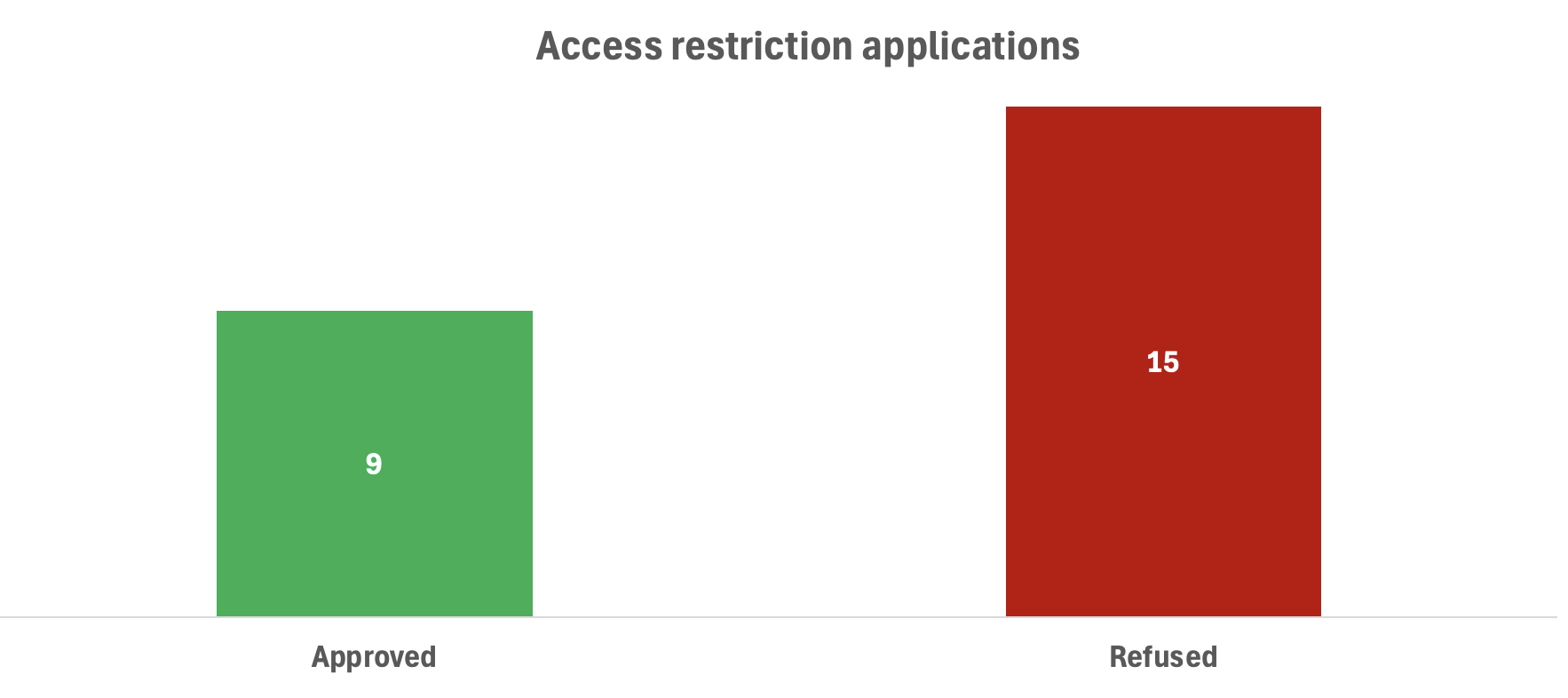
The relatively higher volume of access restriction applications compared to LIA applications (24 versus 12) suggests that demand among beneficial owners for personal protection from disclosure outpaces demand among journalists, researchers, and civil society groups for access to that information.
The access restriction mechanism has been characterised in some commentary as a potential escape route for wealthy beneficial owners seeking to shield themselves from accountability. The 60% refusal rate does not support that characterisation. The competent authority is refusing the majority of applicants, which means it is applying the serious harm threshold with genuine rigour.
The international context
The Cayman Islands’ approach to beneficial ownership transparency has been shaped, and continues to be shaped, by the tension between two competing pressures: the UK government’s sustained advocacy for fully public registers across its overseas territories, and the jurisdiction’s own constitutional privacy protections in line with the evolving international standard.
The international standard has clearly moved in Cayman’s direction. The 2022 judgment of the Court of Justice of the European Union in Sovim SA v Luxembourg Business Registers held that fully public beneficial ownership registers constituted a disproportionate interference with the right to privacy.
The ruling prompted EU member states to step back from the public-access model envisaged under the Fifth Anti-Money Laundering Directive. The Financial Action Task Force, for its part, has not required public registers as a condition of compliance with its beneficial ownership standards.
The Cayman Islands’ legitimate interest model, access for those who can demonstrate a specific, evidence-based need linked to financial crime prevention, is therefore fully aligned with the international consensus.
The Cayman Islands was the first British Overseas Territory financial centre to implement a legitimate interest beneficial ownership access regime in a deliberate effort to balance transparency with the constitutional rights to privacy and data protection guaranteed under the Cayman Islands Constitution.
It is worth noting, and is sometimes overlooked in the debate, that the Cayman Islands is a separate constitutional jurisdiction from the UK with its own legal system and Bill of Rights.
Indeed, the relevant privacy and data protection protections contained in the Cayman Islands Constitution are closely aligned with those recognised under European human rights law. Article 9 of the Cayman Islands Constitution contains privacy protections broadly analogous to Article 8 of the European Convention on Human Rights. The principle of access based on legitimate interest likewise follows the position adopted by European courts, which have recognised that unrestricted public access to beneficial ownership information may infringe fundamental rights.
The Cayman Islands is therefore not resisting transparency but implementing it in a manner consistent with the rule of law, constitutional requirements and internationally recognised human rights principles.
Against this backdrop, the Beneficial Ownership Transparency (Legitimate Interest Access) (Amendment) Regulations, 2026, which introduce a CI$250 annual fee for access to the register on a legitimate interest basis, represent a further incremental step in the direction of broader access, while maintaining the controlled framework in terms of demonstrating a link to suspected financial crime on each occasion.
Whether this satisfies the UK’s position remains a live question. The early data suggest that Cayman’s legitimate-interest access mechanism strikes the right balance between legitimate access to beneficial ownership data and constitutionally protected privacy rights.