
Private credit activity in the Middle East continues to expand in scale and sophistication. Sponsors, institutional investors, family offices and financial institutions are deploying capital through a wide range of lending, co-investment and structured financing arrangements.
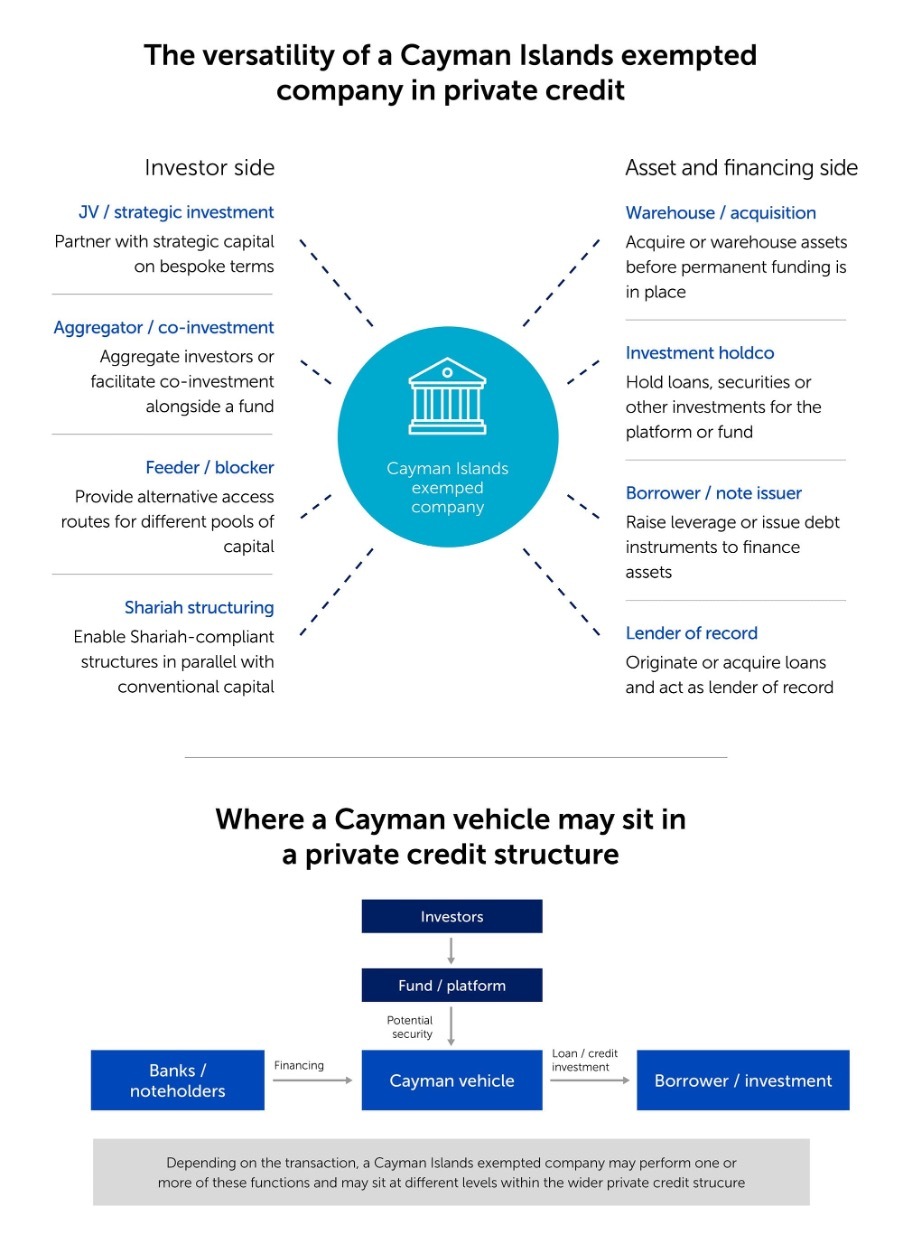
The Cayman Islands exempted company gives sponsors and investors a familiar and flexible way to meet different requirements within the same transaction. It can bring investors together, accommodate tailored economic and governance rights, hold investments, raise finance, issue debt or deploy capital as a lender.
This flexibility can be particularly valuable where several requirements arise within the same transaction. A Cayman Islands company may sit:
- at investor level as a joint venture, aggregation, co-investment, feeder or blocker vehicle
- within the investment structure as an acquisition, warehouse or holding company
- within the financing itself as borrower, issuer of debt instruments or lender.
Sponsors and investors can tailor each vehicle’s ownership, capitalisation, governance and financing arrangements while retaining a corporate form familiar to international financial institutions and institutional investors.
This is the fourth article in our series on private credit in the Middle East. Our first article considered orphan issuer vehicles. The second examined scalable lending platforms using Cayman Islands segregated portfolio companies (SPCs). The third considered the regulatory framework applicable to Cayman Islands private credit structures.
Here we look at the broader versatility of the Cayman Islands exempted company and some of the ways in which it can be deployed within a private credit transaction.
Why use a Cayman Islands exempted company?
The versatility of the Cayman Islands exempted company stems from the flexibility of the corporate form itself. It can be established with a straightforward ownership and governance structure or tailored to accommodate more complex investor, financing and operational arrangements.
Its constitutional documents can provide for different classes of shares, economic and voting rights, board appointment rights, reserved matters and transfer restrictions. Funding can come from equity, shareholder debt, or third-party financing. The company can acquire and hold investments, incur borrowing, issue debt and grant security and, where appropriate, deploy capital directly into an underlying financing.
For private credit sponsors and investors, the practical advantages include:
- flexible ownership and governance, allowing the corporate arrangements to reflect the economics and decision-making requirements of the relevant investors
- flexible capitalisation, including equity, shareholder funding and external leverage
- ability to hold a broad range of investments, including loans, debt securities and equity interests
- ability to borrow, issue debt and grant security, allowing financing to be introduced at the appropriate level of the structure
- tax neutrality, supporting its use in cross-border investment and financing structures
- investor and lender familiarity, particularly among international financial institutions, asset managers and institutional investors
- stable and creditor-friendly legal framework, based on English common law principles, providing a predictable and well-established environment for investment, financing and security arrangements and facilitating access to international capital
- established corporate, fiduciary and compliance infrastructure, allowing the governance and operational arrangements around the vehicle to develop with the requirements of the transaction.
These features allow a single corporate form to perform different functions within a private credit structure.
Multiple private credit uses
Bringing sponsors and capital providers together
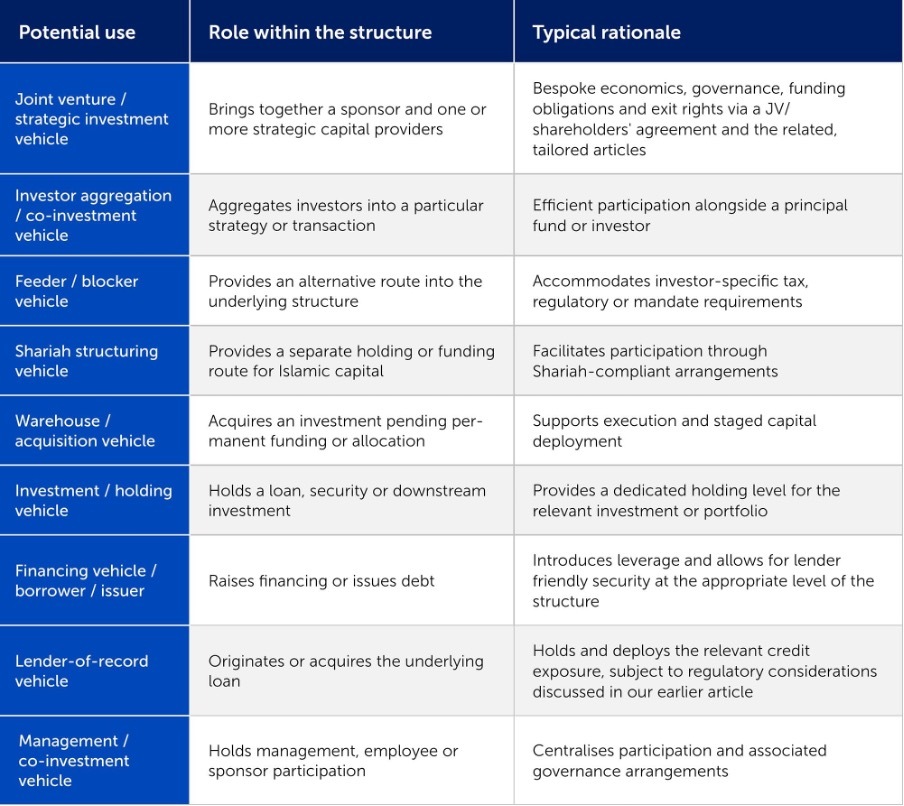
At investor level, a Cayman Islands company can provide the corporate framework through which sponsors and their capital providers invest together.
For a joint venture or strategic investment platform, its articles and any shareholders’ agreement can accommodate negotiated economics, governance rights, board representation, reserved matters, funding obligations, transfer restrictions and exit arrangements.
The same corporate flexibility can be used for co-investment and investor aggregation vehicles. This allows additional investors to participate in a particular transaction or strategy without becoming direct participants in the principal fund or holding structure.
Feeder and blocker vehicles can provide different routes into the same investment for investors with particular tax, regulatory or mandate requirements.
Cayman Islands companies can also form part of Shariah-compliant investment or funding structures where Islamic capital needs a separate route into the underlying transaction.
Holding investments and introducing finance
Further down the structure, a Cayman Islands company can acquire and hold loans, securities, equity interests or other investments.
It can also serve as an acquisition or warehouse vehicle where an investment must be completed before permanent fund or co-investor capital is available. Once the permanent structure is in place, the vehicle may remain as the investment holding company or the asset may be transferred to the relevant long-term holder.
A Cayman Islands company can also be the point at which leverage is introduced. It may borrow under a warehouse, acquisition, NAV or portfolio facility, issue secured or unsecured debt and grant security over its assets and rights.
The Cayman Islands’ established legal framework for creating and enforcing security interests makes it a familiar jurisdiction for secured financing transactions. This allows the parties to place the ownership and financing arrangements at the level best suited to the transaction.
Deploying capital as a lender
A Cayman Islands company may also sit directly on the deployment side of a private credit transaction.
Subject to applicable regulatory, economic substance, and local law analysis, it can originate a financing, acquire an existing loan, or act as lender of record. This can provide a dedicated vehicle through which a fund or investment platform deploys and holds exposure to a particular borrower, portfolio, or strategy.
Where appropriate, the same vehicle can itself be funded through equity, shareholder debt or third-party leverage, allowing the capital and financing arrangements above the vehicle to be structured separately from the underlying credit exposure.
Centralising management and sponsor participation
These companies can also be used to hold management, employee or sponsor participation in a private credit platform or investment.
A dedicated vehicle can aggregate those interests and provide for the relevant economic, voting, transfer, vesting and leaver arrangements. This can be particularly useful where management or sponsor co-investment forms part of a wider institutional structure and the parties wish to centralise those interests through a single shareholder.
Combining Cayman Islands and regional vehicles
Private credit sponsors in the Middle East also have access to established regional corporate structures.
ADGM (Abu Dhabi Global Markets, Abu Dhabi’s financial centre) SPVs are commonly used for holding and investment purposes, while the DIFC Prescribed Company regime has continued to develop and was further revised in 2026 to provide greater flexibility in establishing and using DIFC special purpose structures, which we’ve previously explored here.
Cayman Islands, DIFC and ADGM vehicles can therefore feature at different levels of the same transaction. The appropriate structure will depend on:
- location and requirements of the investors
- the underlying assets
- the financing arrangements
- the intended function of each entity
- the relevant legal, regulatory and tax considerations
This is particularly important in cross-border private credit transactions, where international capital, regional assets and financing arrangements may each give rise to different structuring considerations.
Please note that Walkers does not provide DIFC or ADGM legal advice. This article is intended for general information only and should not be treated or construed as legal advice.

Ciaran Bohnacker is a partner in Walkers’ Global Finance & Corporate Group and based in Dubai.

Szymon Durlo is a senior associate at Walkers in Dubai.