- Credit risk transfer (CRT) transactions let banks transfer credit risk to reduce regulatory capital while retaining assets and improving balance sheet efficiency.
- Synthetic CRTs (via CDS or CLNs) are gaining popularity in the US, enabling risk transfer without an asset sale, often using Cayman SPVs as bankruptcy-remote vehicles.
Bank credit risk transfer (CRT) transactions, also referred to as capital relief trades or SRT transactions (which stands for ‘significant risk transfer’ or ‘synthetic risk transfer’), are becoming increasingly popular in the United States market.
Although CRT trades are not new and have been used in Europe for several years, they are gaining more attention in the US as regulators and rating agencies have recognised their benefits in stress-testing models and credit ratings. Our team has been at the forefront of the CRT market for over a decade, helping clients on both sides of CRT transactions across multiple jurisdictions. Here are some essentials we can share, drawn from our experience across different types of CRT transactions involving Cayman vehicles.
What are CRT transactions?
The basic idea of the CRT transaction is that the bank transfers the credit risk of a defined portfolio of assets to a third-party investor, allowing the bank to hold less regulatory capital under US bank capital rules.
What are the types of CRT transactions?
There are two main types of CRT transactions:
- ‘Cash CRT’ – the bank sells or otherwise transfers all or a portion of the assets to a third party. That third party can be an SPV, which then issues securities to investors. This is the traditional securitisation model.
- ‘Synthetic CRT’ – the bank retains ownership of the underlying portfolio but transfers the exposure through a credit derivative or a guarantee. This is often referred to as synthetic securitisation and can offer the bank better returns than the traditional securitisation model. The term ‘synthetic’ is used as the assets remain on the bank’s balance sheet. These can either be funded or unfunded. The majority of the CRT trades we see are in the funded category, i.e., they are secured by specific collateral.
Synthetic CRT transactions – credit default swaps to achieve risk transfer
Although a variety of instruments can be used to achieve risk transfer, credit default swaps (CDSs) are most commonly used.

The bank enters into a CDS with a counterparty related to a specific reference portfolio of loans. As the credit protection buyer, the bank pays a fee (usually called a ‘premium’) to the counterparty, the credit protection seller or provider.
If a ‘credit event’ occurs in relation to a loan in the reference portfolio, the credit protection seller must make a ‘credit protection payment’ to the bank to cover the loss.
Often, the counterparty provides collateral upfront to the bank to cover any credit protection payments it may need to make.
The counterparty is usually an exempted company incorporated in the Cayman Islands that is on-balance sheet but structured so as to be bankruptcy remote through the issuance of ‘golden shares’ to a third-party service provider, such as Walkers Fiduciary Limited, and the appointment of independent directors with the ability to block bankruptcy actions. The shareholder is often a fund established in the Cayman Islands or onshore.
Synthetic CRT transactions – credit-linked notes
The bank can either issue Credit Linked Notes (CLNs) directly or through an SPV.
The SPV-issued CLNs work as follows:
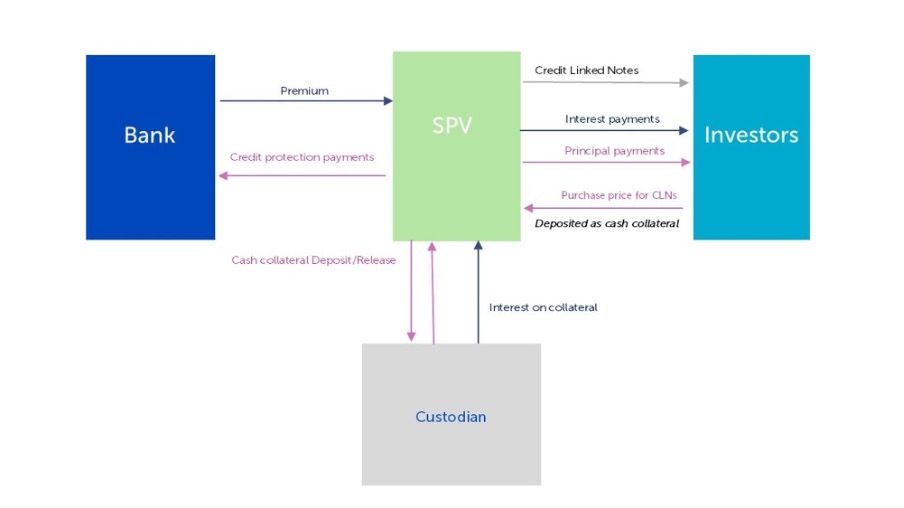
The SPV is normally set up as an orphan entity with all shares held by a company such as Walkers Fiduciary Limited under a declaration of trust, and the board of directors is also fully independent and provided by a company such as Walkers Fiduciary Limited.
The SPV enters into a CDS with the bank, whereby the bank pays a premium to the SPV as a fee for offering credit protection. The SPV also issues CLNs to investors. The SPV uses the proceeds of CLNs as collateral for the CDS and as security for principal payments on the CLNs. A custodian usually holds the proceeds.
If a credit event occurs under the CDS, the collateral is used to make the relevant credit protection payments to the bank and the principal balance of the CLNs is reduced by that amount. If no credit events occur, the collateral is released and used to pay the principal on the CLNs.
The interest payments on CLNs are funded by the premium paid by the bank under the CDS and the interest earned on collateral while it is with the custodian.
The noteholders can finance the acquisition of CLNs through a loan from another bank secured by the CLNs.
As the SPV is often based in the Cayman Islands, where service providers will form the SPV and advise on all Cayman aspects of the transaction, including making sure that the SPV is in compliance with all Cayman regulatory regimes, such as AML, FATCA/CRS, economic substance, beneficial ownership and ensuring CRT transactions are not within the financial services regulatory scope. They can also act as share trustee, provide directors and act as registered office and administrator of the SPV.
Why are synthetic CRT transactions becoming more popular?
For the Bank, entering into the CRT transaction reduces the regulatory capital it must hold against the asset portfolio, and this cost saving outweighs the costs of funding the transactions/paying the premium. It also allows the bank to transfer only the credit risk, not all other benefits associated with the assets, since the assets remain on the balance sheet. The Federal Reserve also issued guidance in September 2023, which provides more clarity to the market on the treatment of these transactions, which is supporting interest and activity.
The arbitrage for investors entering into CRT transactions is essentially based on the regulatory capital risk weighting of these loans not accurately reflecting the commercial realities of default risk. Viewed slightly differently, in a transaction involving a well-originated loan portfolio, investors gain exposure to a pool of quality loans which they may not have the infrastructure and balance sheet to originate themselves. The hope, ultimately, of course, is that the fee/premium they receive for offering capital relief will outweigh any losses they will actually suffer.

Olga Sologub is a partner at Walkers and specialises in structured finance and derivatives, collateralised loan obligations (CLOs), securitisations and bespoke structured products.