
More than half of the world’s emerging hedge fund managers continue to choose the Cayman Islands as the domicile for their flagship funds, reinforcing the jurisdiction’s position as the leading offshore centre for the sector, according to a new industry survey by the Alternative Investment Management Association (AIMA) and Marex.
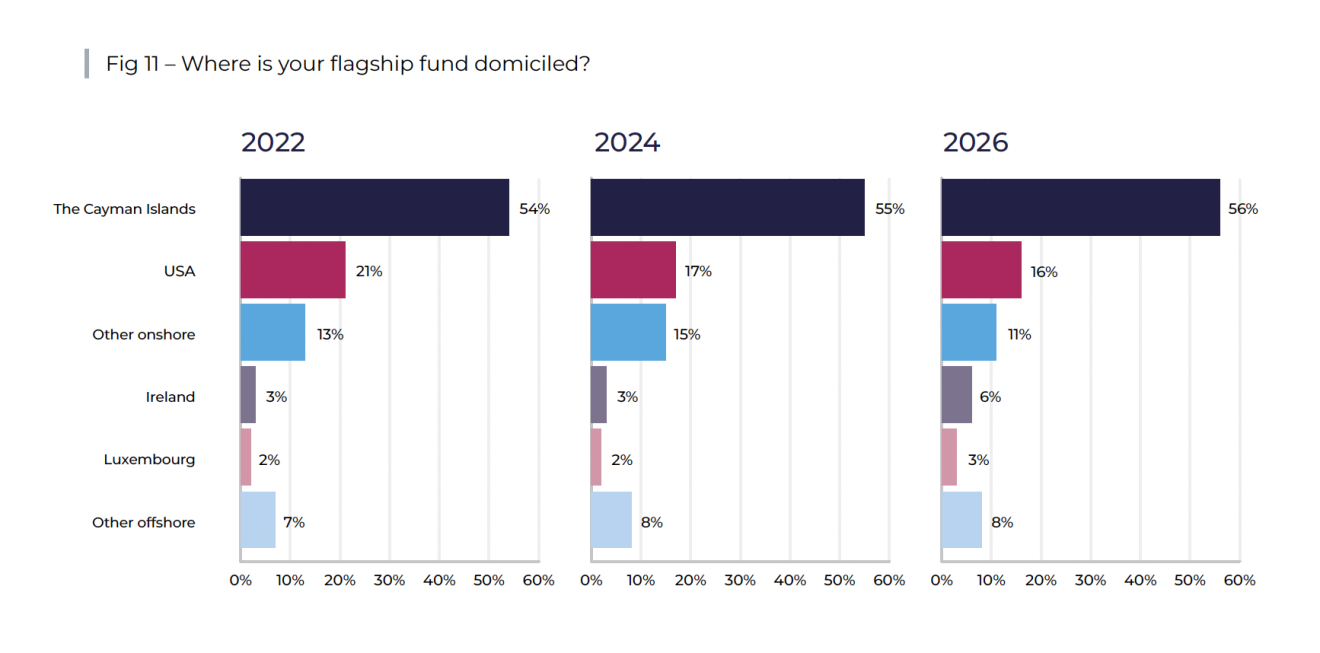
The Stacking Up: 2026 Emerging Manager Survey, based on responses from 180 hedge fund managers and 50 institutional investors, found that 56% of respondents domiciled their flagship fund in the Cayman Islands, up marginally from 55% in 2024 and 54% in 2022. The United States remained the second most popular domicile at 16%, while Ireland and Luxembourg continued to gain modest ground.
The findings suggest that although European fund structures are attracting increased attention, Cayman continues to underpin the global emerging hedge fund market. According to the report, Cayman and the United States together account for 72% of flagship fund domiciles, unchanged from the previous survey, highlighting the continued preference among managers for established fund jurisdictions.
Samantha Widmer, Director for Funds and Capital Markets at Cayman Finance, said: “This report confirms the central role of the Cayman Islands in servicing emerging hedge funds, even as investor preferences for alternative investment structures evolve. While managers are increasingly offering onshore and managed account options to meet investor demand, Cayman continues to be the jurisdiction of choice for the majority of emerging hedge fund launches and remains particularly attractive to larger institutional investors.”
The report notes that Cayman has consistently been the preferred domicile for emerging hedge funds since the survey series began in 2017, reflecting its longstanding role within the broader hedge fund industry. While Ireland’s share increased from 3% to 6% and Luxembourg’s from 2% to 3%, the authors said these changes may indicate that some managers are considering European Union-regulated structures to appeal to institutional investors, rather than signalling any broad shift away from Cayman.
Beyond domicile trends, the survey found that emerging hedge fund managers are becoming increasingly institutional in their operations. Average assets under management among respondents rose to $233.7 million, while firms reported larger workforces and greater investment in governance, technology and operational infrastructure.
According to AIMA and Marex, the findings point to an emerging manager sector that is becoming more sophisticated operationally while benefiting from a more supportive fundraising environment than in recent years. Although firms continue to face rising operating costs and higher breakeven levels, the survey suggests investors are increasingly rewarding managers that demonstrate institutional-quality infrastructure from an earlier stage.
“The findings highlight a more sophisticated emerging manager landscape, where investors are increasingly backing firms that demonstrate operational excellence, innovation, and strong governance—attributes that are well supported by Cayman’s institutional ecosystem” Widmer said.
The proportion of managers taking more than five years to surpass $100 million in assets fell from 56% in 2024 to 28% in 2026, suggesting newer firms are scaling more quickly.
Investors also appear increasingly prepared to allocate capital earlier in a manager’s lifecycle. The average track record required before making an investment declined from 1.52 years to 1.27 years, with 58% of investors now willing to consider funds with a one-year track record or less. According to the report, this reflects growing confidence in managers’ operational capabilities rather than relying solely on longer performance histories.
Long-short equity remained the most common strategy among emerging managers, accounting for 36% of respondents, while it was also the strategy most favoured by investors, attracting 54% of investment allocations. Multi-strategy and global macro rounded out the most popular approaches.
Fee levels remained largely unchanged despite competitive fundraising conditions. The average management fee edged up to 1.43%, while the average performance fee remained stable at 16.24%. Rather than reducing fees, managers increasingly sought to differentiate themselves by strengthening investor protections, including wider use of hurdle rates and high-water marks.
The report further highlighted the changing profile of smaller firms managing less than $100 million. These managers reported increasing headcounts, greater investment in technology and compliance, and growing use of artificial intelligence. More than two-thirds said they were using AI in some capacity, with almost 40% deploying it across all areas of their business. Investors also showed increasing willingness to allocate to smaller firms, with more than half indicating they would consider investing in managers overseeing less than $50 million in assets.