The asset management industry is undergoing a profound transformation driven by blockchain technology and tokenisation. Tokenisation is the method of representing real-world assets, such as equities, bonds, fund interests or real estate, as digital tokens on a distributed ledger.
Tokenised real-world assets on public blockchains recently exceeded $20 billion in market capitalisation. BlackRock’s BUIDL fund crossed $2.9 billion in assets under management within a year of launch. Research by Calastone projects that assets under management in tokenised funds will grow from $4 billion in 2024 to $235 billion by 2029.
Writing in The Economist in December 2025, BlackRock’s Larry Fink and Rob Goldstein compared the moment to the internet in 1996. Tokenisation could advance at the same pace, they argue, “faster than most expect, with enormous growth over the coming decades.”
They believe tokenisation will enable assets to move faster and more securely than the systems that have served investors for decades. By lowering cost and complexity, tokenisation could also give more investors more ways to diversify.
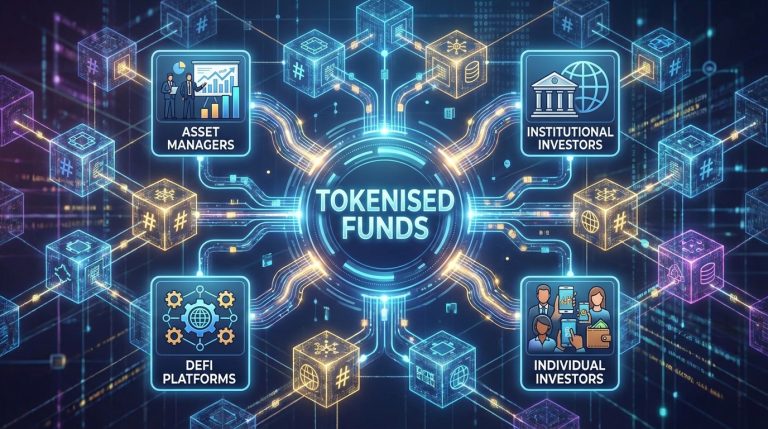
While the technology is still maturing, several distinct groups are actively pursuing tokenised funds for their potential to reshape the foundations of financial markets.
Asset managers: efficiency and new investor groups
Established asset managers like BlackRock, Franklin Templeton or Fidelity consider tokenisation from an access and cost perspective. They are interested in tokenisation to modernise ageing infrastructure that remains riddled with manual processes. By using a single, shared “source of truth” on a blockchain, asset managers expect to significantly reduce costs associated with data reconciliation and fund accounting. Calastone’s research suggests that these efficiencies could provide a $135 billion boost to P&L for the global fund industry.
Asset managers also view tokenisation as a proactive growth strategy to reach untapped “on-chain” capital. These are investors who already operate within the digital asset ecosystem and seek institutional-grade products.
Moreover, the ability to use smart contracts could allow managers to offer high levels of personalisation and automated risk management, such as portfolios that automatically rebalance when a credit rating drops.
Institutional investors: unlocking private markets
Institutional investors, including pension funds and family offices, are drawn to tokenised funds for access to previously illiquid private markets. Private credit, private equity, real estate and infrastructure have historically been illiquid, opaque, paper-intensive and inaccessible below very high minimum investment thresholds.
Tokenisation addresses these issues. It enables fractional ownership, breaking high-cost assets like private credit and infrastructure into smaller, more accessible units. Programmable compliance, in turn, can automate transfer restrictions, and secondary-market infrastructure can provide an easier exit route. Private credit is already the largest tokenised asset category, with approximately $12.5 billion on-chain.
Surveyed asset owners also cite enhanced security and auditability as top benefits, since blockchain provides a permanent, tamper-proof record of every transaction. And the potential for instantaneous settlement can reduce counterparty risk, as cash and assets are swapped simultaneously on-chain.
DeFi platforms: effective on-chain treasury management
Perhaps the least widely appreciated driver of demand comes from DeFi and Web3 platforms themselves. These entities have accumulated substantial balance sheets. Yet three-quarters of DeFi platforms still manage their cash through traditional money market funds or bank deposits because blockchain-compatible yield products do not yet exist widely.
Calastone’s research found that 80% of DeFi platforms believe access to tokenised money market funds would benefit their treasury management by offering low-risk, yield-bearing assets on-chain. These platforms also want to use tokenised funds to retain client assets and attract new users who want traditional financial stability without leaving the digital “rails”.
Individual investors: access and immediacy
For individual investors, tokenisation represents the democratisation of investment opportunities. Younger generations increasingly expect a direct, instant relationship with their investments, often preferring digital platforms and apps over traditional intermediaries.
It is expected that tokenisation could meet this demand by providing 24/7 trading and shorter settlement times. By lowering entry barriers through fractional units, retail investors might be able to access high-value asset classes that were historically reserved for the wealthy.
Technology meets regulation
However, as BlackRock’s Fink and Goldstein note, “Technology alone won’t remove every barrier. Regulation and investor safeguards will remain essential.”
Just because a token can be transferred near-instantaneously on-chain, the recipient must still meet investor suitability requirements before that transfer is legally valid.
While technology can enable higher transaction speeds, it does not, therefore, eliminate the need for a compliance framework. For example, enhanced liquidity in private market funds will not be automatic. In less liquid strategies, secondary-market liquidity will depend on a so-called whitelist of pre-approved, KYC-verified investors.