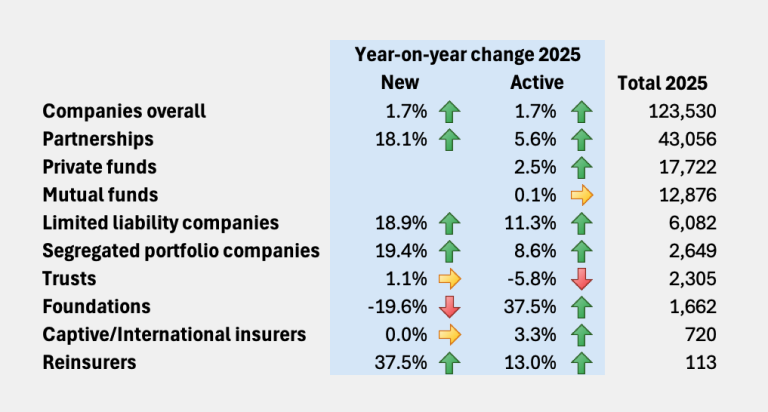
Source: Cayman Islands General Registry, CIMA.
Corporate activity in the Cayman Islands reached a new high in 2025. Data published by the Cayman Islands General Registry show that the number of active companies and partnerships climbed to record levels, reflecting both sustained growth in traditional fund structures and rising demand for vehicles designed for capital market access, insurance, digital assets and private wealth planning.
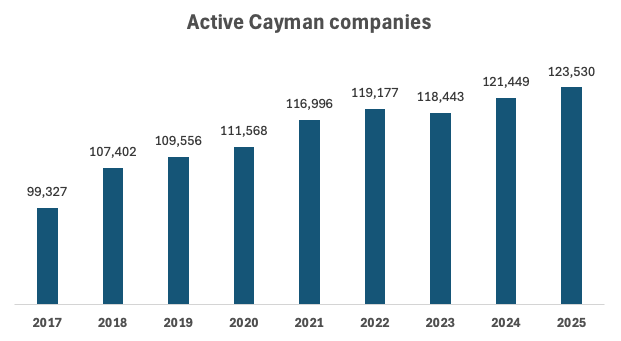
The number of companies on the register increased by 2,081, or 1.7%, to 123,530, while new company registrations reached 13,306 – the highest annual figure since 2021.
Partnership growth was even stronger. Active partnerships rose by 2,293, or 5.6%, to 43,056, closely tracking continued expansion in global private markets and fund formation activity.
Cayman’s entity regime serves as infrastructure for cross-border investment strategies, capital markets transactions and decentralised digital projects that require legally robust and flexible vehicles capable of operating across jurisdictions.
Private capital continues to drive partnership growth
Some of the company registration figures mirror fund formation statistics. In the second and third quarter of 2025, the number of mutual funds briefly crossed the 13,000 threshold before easing back to 12,876 active funds at the end of the year, only marginally higher than a year earlier, Cayman Islands Monetary Authority (CIMA) statistics show.
Most mutual funds, which are often hedge funds, are established as exempted companies and segregated portfolio companies, but exempted limited partnerships and unit trusts, for institutional investors seeking trust-based structures with trustee oversight, are also used for open-ended funds.
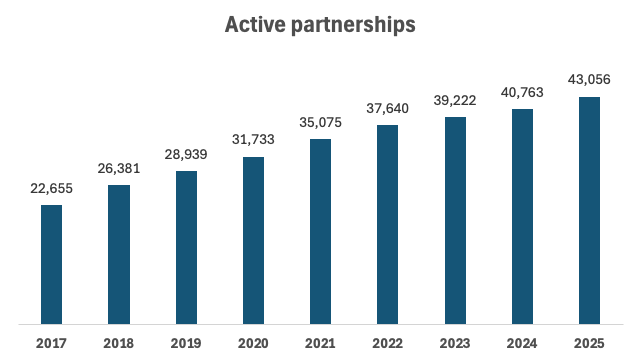
The rise in partnerships reflects mostly the continued expansion of private equity, private credit and venture capital markets. Exempted limited partnerships (ELPs), the dominant structure for private investment funds, remain central to the pooling of institutional capital globally. Pension funds, sovereign wealth funds and insurance investors typically participate as limited partners, while managers operate through general partner entities that control investment decisions.
As banks have retreated from certain types of lending since the global financial crisis, private credit funds have expanded rapidly, requiring scalable partnership structures capable of accommodating complex investor arrangements and capital call mechanics. Cayman partnerships are widely used because they align closely with US partnership concepts familiar to investors while offering contractual flexibility and tax neutrality for cross-border capital flows.
The growth in partnerships, therefore, mirrors broader trends in global asset allocation, while increasing institutional allocations to alternatives continue to translate directly into entity formation activity.
Exempted companies remain the backbone of capital market structures
In addition to investment structures, exempted companies have, due to their flexibility, continued to be relevant across capital markets, structured finance, and holding company arrangements.
Multinational groups frequently place a Cayman exempted company above operating subsidiaries in multiple jurisdictions. This simplifies ownership, facilitates joint ventures between investors from different countries, and enables capital raising or restructuring without being tied to a single domestic tax regime. Many companies that later list on Nasdaq or the New York Stock Exchange are Cayman exempted companies serving as the listed parent entity.
Another major use is in capital markets and structured finance transactions. Exempted companies are commonly established as special-purpose vehicles for securitisations, collateralised loan obligations (CLOs), and aircraft and shipping finance. The legal framework allows assets and liabilities to be isolated within bankruptcy-remote entities, which is essential for credit structuring and investor protection.
One area illustrating the flexibility of exempted companies is the re-emergence of special purpose acquisition companies (SPACs). A SPAC is a company created to raise funds from investors and then use that money to acquire or merge with an existing private business, allowing that business to become publicly listed.
After a sharp contraction following the record issuance boom of 2021, global SPAC activity stabilised during 2024 and 2025. Approximately 116 SPAC IPOs were completed globally in 2025, with more than 95% incorporated in the Cayman Islands.
While SPACs represent a smaller share of overall incorporation activity, their continued dominance in Cayman highlights the jurisdiction’s role as a neutral platform for cross-border public market access.
SPAC sponsors favour Cayman exempted companies for their compatibility with US listings, flexible share class structures and efficient statutory merger regime, which simplifies the business combination process.
Recent deals increasingly target sectors such as artificial intelligence, life sciences and energy transition technologies.

Limited liability companies gain ground
Cayman limited liability companies (LLCs) are another example of steady company formations. They recorded 1,021 new registrations in 2025, continuing a multi-year upward trend.
LLCs combine corporate personality with partnership-style economic flexibility. Unlike a conventional Cayman exempted company, the internal governance of an LLC is almost entirely determined by a private LLC agreement, as opposed to statutory rules or constitutional documents.
This allows members to allocate economic rights, voting power, profit participation and management authority in highly customised ways to better reflect commercial arrangements rather than a prescribed corporate structure. This makes LLCs particularly attractive for private equity sponsors, joint ventures and general partner vehicles within fund structures.
Their adoption also reflects increasing complexity in global investment arrangements. The contractual flexibility means members can structure capital accounts, distributions and decision-making mechanics in a way that mirrors partnership economics, including waterfall arrangements, carried interest structures and bespoke governance rights.
LLCs provide this flexibility while maintaining limited liability protection, which explains their growing role in sponsor entities, co-investment platforms and digital-asset operating structures.
Foundation companies provide solutions for digital assets and private wealth
Among the fastest-growing entity types in recent years has been the Cayman foundation company. Although new registrations eased slightly to 475 following a record year with 590 new registrations in 2024, overall growth remains strong, with more than 1,660 foundations now on the register, of which approximately 90% are foundation companies.
Foundation companies occupy a hybrid space between companies and trusts. They possess separate legal personality but operate without shareholders, instead pursuing defined purposes overseen by directors and supervisors. This structure has proved particularly suited to decentralised governance models emerging in the Web3 ecosystem.
Decentralised autonomous organisations (DAOs), which rely on token-holder voting and smart contracts, lack inherent legal personality. Foundation companies provide a legally recognised interface with traditional financial systems, allowing protocols to hold assets, enter contracts and manage treasuries while limiting liability for participants. Legal developments abroad highlighting risks for unincorporated DAOs have accelerated the adoption of this structure.
At the same time, private wealth advisers increasingly use foundation companies for succession planning and family governance. Their flexible governance arrangements allow families to combine professional management with oversight mechanisms, supporting long-term stewardship of diverse assets ranging from operating businesses to digital investments.
Segregated portfolio companies return to favour
Segregated portfolio companies (SPCs) also experienced renewed momentum, with 481 new registrations in 2025, continuing a multi-year rebound.
SPCs allow multiple legally segregated portfolios to operate within a single corporate entity, ensuring assets and liabilities remain ring-fenced between investment strategies. After falling out of favour in the 2010s amid concerns about cross-border recognition, the structure has regained acceptance as legal certainty improved and market familiarity increased.
The revival also reflects changing investor expectations. Institutional investors increasingly demand customised mandates, co-investment solutions and separately managed accounts. SPC platforms allow managers to launch tailored strategies quickly while sharing governance and operational infrastructure, reducing cost and complexity.
As asset managers expand into private credit, digital assets, and multi-strategy platforms, SPCs offer a modular approach that balances investor customisation with operational scale.

Technology activity sustains special economic zone growth
Outside traditional financial services, activity within Cayman Enterprise City, the jurisdiction’s special economic zone, remained steady, with 97 new zone companies registered during the year.
These entities are typically technology, commodities trading, IT/software, aircraft/maritime or digital services firms seeking a physical presence aligned with Cayman’s regulatory framework.
There are currently 284 special economic zone companies licensed to operate in the zone, illustrating the diversification of Cayman’s corporate base beyond investment and capital market structures.