Spectrum founder Paul Byles (centre) with Premier André Ebanks, MP Julie Hunter, CIMA CEO Cindy Scotland and other CIMA officals (Photos: Spectrum)
The fifth anniversary of the Spectrum conference at the Kimpton Seafire on Wednesday brought together financial services industry leaders, government officials and regulators in a day-long programme that developed a shared theme: the need for long-term strategy and foresight to sustain the industry’s success.
Opening the conference, Paul Byles, Spectrum’s founder, traced the jurisdiction’s rise from 194 international banks managing $21 billion in 1975 to a world-leading financial centre today. Yet, he cautioned, current prosperity should not be taken for granted. He suggested, Cayman needs a long-term strategy, not just to preserve, but to diversify, empower and sustain it for future generations.
Byles urged continued investment in education, upskilling and entrepreneurship, arguing that Cayman’s human capital will be the decisive factor in maintaining competitiveness in an era of rapid regulatory and technological change.
The message was echoed by Premier André Ebanks, who described the financial services industry as both the largest contributor to the economy and in terms of funding healthcare, education and social safety nets.


Speaking of the sector’s “dual responsibility” to generate growth while protecting against internal and external risk, Ebanks said, for Cayman’s success to endure, the right strategy will need to ensure that innovation, regulation and human development move together.
That includes investing in people, maintaining world-class regulation and preparing early for the next wave of technology — from virtual assets to AI.
The premier and minister for financial services outlined three foundations guiding his Ministry’s policy agenda: structural resiliency and regulatory excellence; regulated innovation; and inclusive prosperity through human capital development.
He also referenced comments by FATF President Elisa de Anda Madrazo that virtual assets and beneficial ownership would be the key focus of the FATF and central to the Cayman’s preparations for the FATF’s fifth-round mutual evaluation beginning in 2026.
The judiciary as a cornerstone
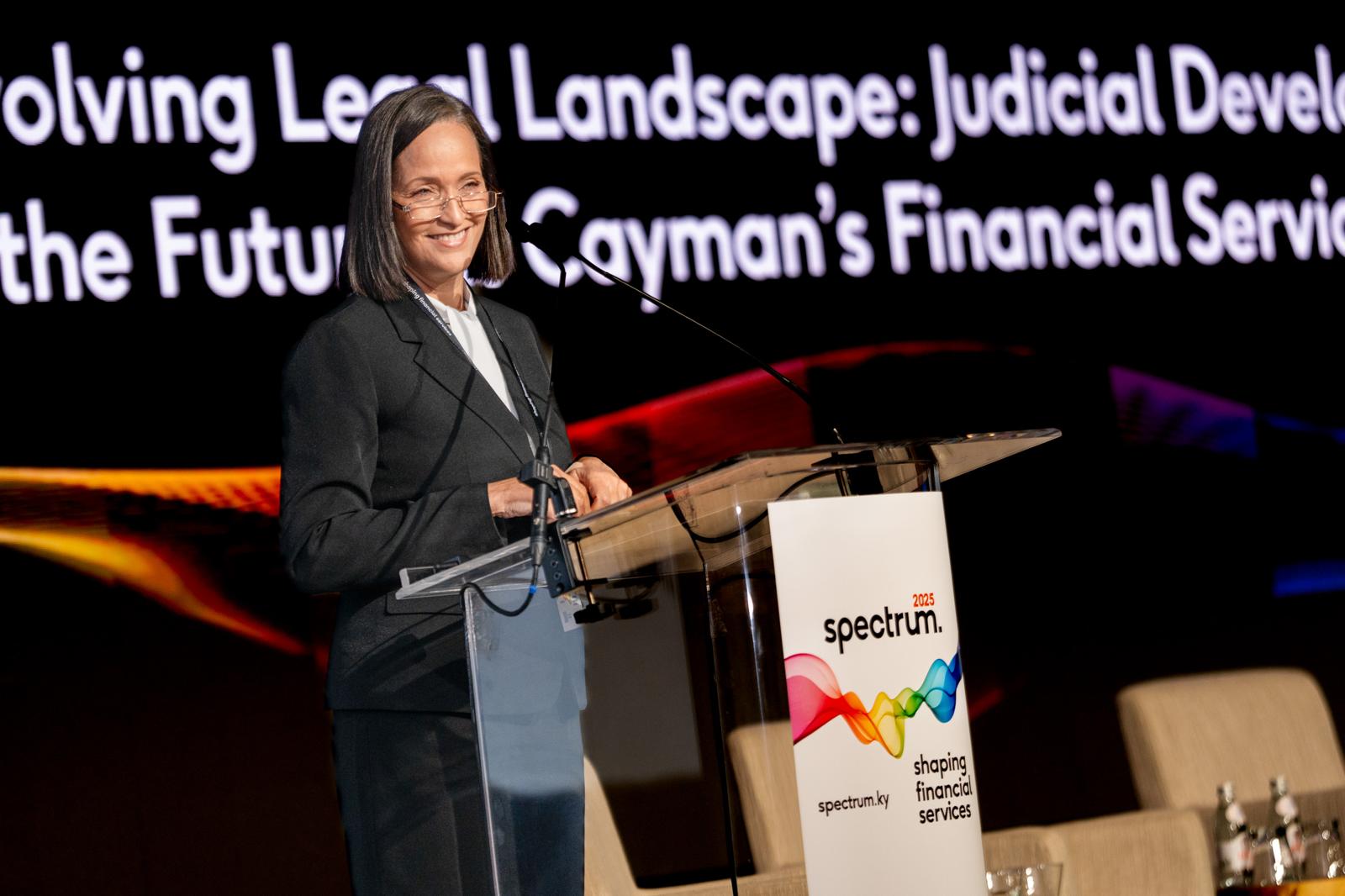
Chief Justice Margaret Ramsay-Hale stressed, in her keynote remarks, that the rule of law itself forms part of Cayman’s economic infrastructure. The judiciary, she said, is a key pillar supporting Cayman’s competitiveness, investor confidence and international credibility.
No matter how good your laws or the regulatory regime are, no one will invest unless they have confidence that the law will be applied consistently, disputes resolved promptly and fairly, and the courts remain independent of political or commercial pressure, she said.
Ramsay-Hale pointed to innovation within the judiciary, including electronic filing, the Financial Services Division’s continued expansion, and forthcoming integration of AI in case-management systems and blockchain for evidence verification. These initiatives, she said, were part of a broader effort to modernise the courts.
Her comments provided a natural bridge to one of the day’s most animated panels about artificial intelligence and its implications across financial services.
AI: opportunity and caution
The AI in Insurance panel drew perspectives from regulators, innovators and insurers. Insurance industry representatives Suzanne Sadlier and Jay Madhu agreed that AI is already transforming underwriting, claims handling and customer engagement.
Sadlier observed that AI is already more prevalent in banking and insurance than in asset management, while Madhu suggested its potential to reduce costs and improve claims efficiency could have systemic benefits.
UCCI’s Tamsin Deasey-Weinstein, who leads workforce and digital transformation projects, took the argument further, saying AI would ultimately change not just business processes but business models.
While being a self-proclaimed AI optimist, she warned that AI adoption without education could widen skill divides. For AI truly enhance business and productivity, AI literacy must become a universal skill for everyone in the workforce, she said.
Samuel Jacques-Cloutier, a former policy analyst in the Ministry of Financial services, cautioned that Cayman’s experience building the virtual asset framework offered lessons in the need for sound governance before rapid adoption. While AI is very exciting, he said, progress needs to come at a measured pace until the right frameworks are in place.
DAOs and the rise of new governance models
Another discussion explored decentralised autonomous organisations (DAOs) and their emerging role in finance. Panellists Melissa Lim, Sarah Wheeler and Alastair Lagrange explained how DAOs – communities governed transparently by token-based voting and blockchain-recorded decisions – are reshaping ideas of corporate structure and accountability.
Cayman’s foundation company has become a preferred legal wrapper for DAOs needing a real-world presence. Lim noted that more than 1,200 foundation companies have now been registered since 2023, far exceeding early expectations when the law came into effect.
Speakers debated whether bespoke DAO legislation is needed, given that US state Wyoming and the Marshall Islands recently issued DAO-specific laws. However most agreed that, for the time being, Cayman’s foundation company and virtual asset services provider (VASP) framework already gives innovators the certainty they need while allowing regulators to maintain oversight.
The numbers speak for themselves, said Cayman Finance Associate Director Haymond Rankin, adding that it is important to continue to refine and tweak Cayman’s legislation, if needed.
Future-proofing Cayman’s funds industry
A separate session on funds and competitiveness reinforced similar themes. Chantelle Day, Matt Taber, Tamis McDonald and Louise Somers argued that Cayman had reached a stage of regulatory maturity, having met or exceeded global standards across tax transparency and AML frameworks.
Future success, panellists said, will depend on being proactive rather than reactive, anticipating new asset classes, tokenisation and digital-asset integration.
Tokenisation, in particular, could offer key benefits and broaden investor access by allowing fund interests to be divided into smaller, tradeable digital units in a potential evolution of Cayman’s funds sector as it integrates digital-asset technology.
Panellists also called for continued collaboration between the private sector and government to ensure Cayman remains both compliant and competitive in emerging investment areas.
The regulator’s agenda
The conference also featured a regulatory panel moderated by Paul Byles, featuring CIMA Managing Director Cindy Scotland alongside sector-specific regulators.
Scotland outlined three core priorities guiding the regulator’s strategy into 2026: enhancing regulatory frameworks, embracing digital transformation, including AI, and strengthening operational resilience.