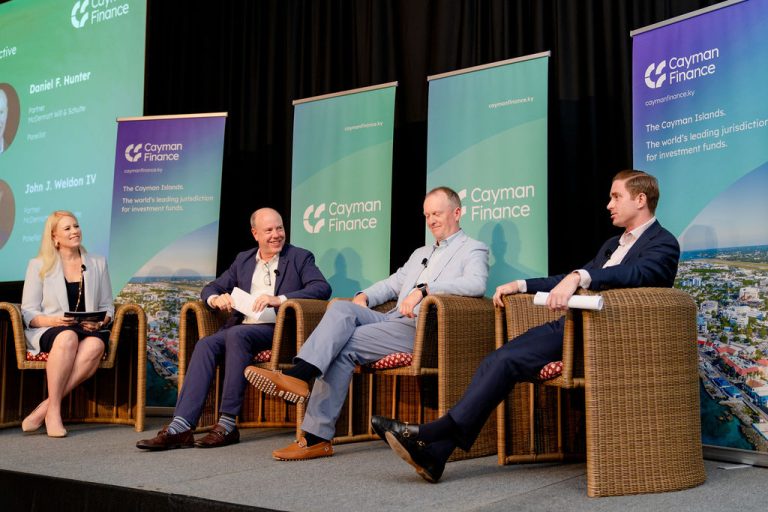
Cayman Finance Associate Director Samantha Widmer moderated a panel with McDermott Will & Schulte partners Daniel Hunter, Peter Naismith and John Weldon.
Three senior funds attorneys from the newly merged McDermott Will & Schulte outlined key developments shaping the funds industry at Cayman Finance’s third member event this year on Friday, 12 Sept.
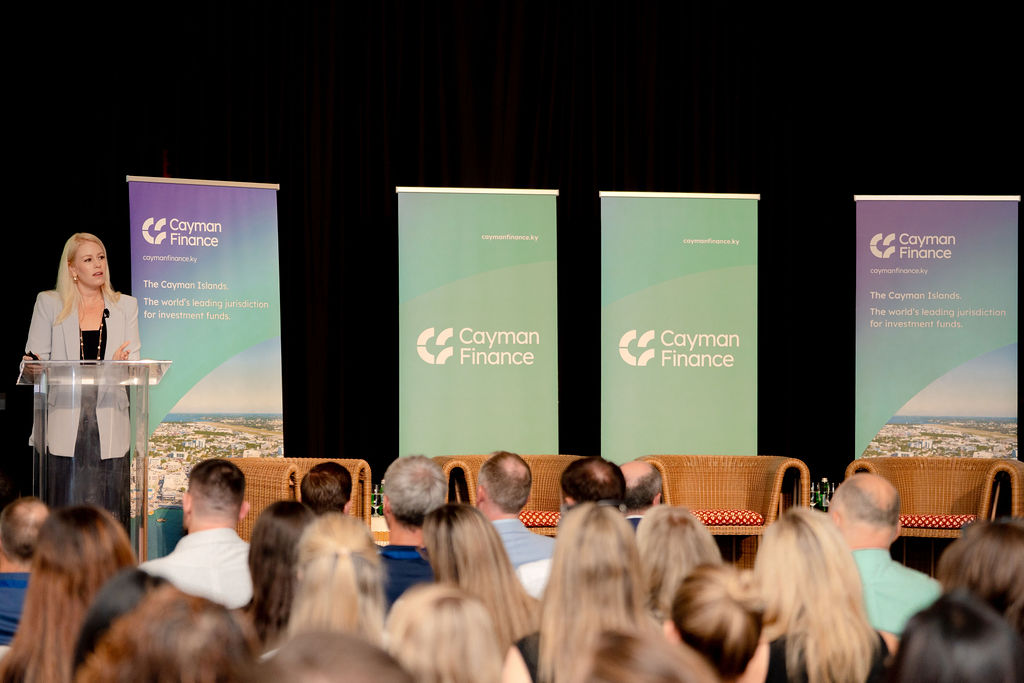
Speaking in front of more than 250 delegates, Daniel Hunter, Peter Naismith and John Weldon addressed trends in hedge funds and private equity, Cayman’s regulatory strengths, misconceptions about offshore structures, the growing role of artificial intelligence and the strategic agenda for 2026.
Funds industry trends
Hedge funds are enjoying renewed investor interest after years of scepticism and a period in the shadow of private equity, according to Daniel Hunter. He noted that private equity managers, once celebrated for Yale-style endowment returns of more than 20% in 2021, are now struggling to generate cash for investors.
“Private equity fundraising has slowed. Hedge funds, by contrast, are benefiting from their liquidity and flexibility,” said Hunter. “Investors are again comfortable paying fees if it means access to capital that isn’t locked up for a decade.”
Hedge funds have delivered around 4.5% returns so far this year and are seeing inflows.
Naismith agreed that hedge funds are enjoying renewed attention but cautioned that fundraising remains uneven. Much of hedge fund growth in 2024 stemmed from performance rather than new inflows, with investors benefiting from robust returns rather than adding fresh capital. “This year, the pendulum has moved a little bit back in favour of hedge funds when it comes to fundraising,” he said, but it remains “challenging outside the largest players”.
Naismith contrasted this with private equity’s more constrained environment. Private equity managers continue to face difficulties in securing commitments. “Unless you’re seeing exits from investments, it’s really hard to get offices to re-up to new funds,” Naismith said.
Meanwhile, private credit has become a significant topic of the year. Still, Naismith cautioned that the sector is not without challenges, suggesting the market will be closely watching how managers balance rapid growth with evolving risks. Credit funds are also in a holding pattern as investors wait to see how interest rates evolve, Hunter added.




















The rise of access funds
Weldon highlighted the sharp rise of “access funds,” vehicles that aggregate high-net-worth investors to meet institutional minimum investment requirements.
He explained that access funds serve high-net-worth individuals who have the wealth and eligibility to invest in private funds but often face prohibitively high minimum commitments as those funds increasingly target large institutional investors. Historically, banks aggregated their private clients into vehicles that invested in underlying funds, but the operational burden of audits and redemptions pushed many banks away from the model. Specialist fintech firms have since stepped in to manage these structures, supporting rapid expansion.
Regulatory attitudes have also shifted. While the previous SEC administration sought to limit retail exposure to alternatives, the current administration has encouraged greater access, citing the significant wealth generated in the sector. This policy change has opened the door for wider use of access funds.
For Cayman, Weldon said the trend is already material. “When we form these funds … we are forming a Cayman Islands exempted limited company as an access fund, and it’s on a one-to-one basis,” he noted. Unlike traditional fund-of-funds, the structure links directly to a single underlying fund. This has led to new Cayman fund registrations, not from new managers or products, but from existing managers attracting a different class of investors.
He argued that Cayman’s ability to adapt to such evolving structures demonstrates the jurisdiction’s value compared with rival centres.
Hybrid funds
The panel also pointed to innovation in hybrid funds, which combine features of open- and closed-end vehicles, making adaptability across fund structures no longer optional but central to meeting investor demands for all service providers in an increasingly hybridised market.
“Every manager we advise is considering bespoke products,” Hunter said. “The best lawyers, directors and administrators must now understand both mechanics fluently.”
Naismith agreed and highlighted the growing complexity of evergreen private credit vehicles, stressing that service providers must understand both open- and closed-ended fund mechanics to remain competitive.
“It’s less a selling point and more a necessity,” Naismith said. Without that expertise, he warned, managers, lawyers and administrators risk “tripping over” themselves or others in managing these structures.
“If you’re going to make that the focus of your business, you definitely need to know both sides,” he said, noting the importance of technical fluency for Cayman service providers seeking to differentiate themselves in a rapidly evolving market.
John Weldon emphasised the importance of legal versatility in advising fund managers, noting that clients increasingly expect lawyers to deliver creative solutions that draw on knowledge from both hedge and private equity structures.
He cited the example of crossover funds, where hedge funds with side pockets hold illiquid private investments. In such cases, some investors may end up with only private assets, raising the question of whether those positions should be treated under a private equity-style back-ended waterfall. “If you’ve never done a back-ended waterfall before, you’re not going to come up with that solution for that client,” Weldon said.
Cayman’s international role in funds
Asked why managers continue to select Cayman, the panellists cited a blend of trust, efficiency and established relationships. “Cayman is the second most recognised jurisdiction after Delaware,” Hunter noted. “That reputation must be protected vigilantly.”
Weldon said the Cayman model works because of the relationships built between local professionals and global financial centres such as New York. “It makes it so much easier to work together. It makes it so much easier to launch funds together,” he explained, adding that shared understanding of industry issues means less friction and faster execution.
Naismith emphasised the jurisdiction’s regulatory balance. He said clients want minimal friction with offshore regulators. Cayman achieves that balance, streamlining processes without sacrificing credibility. In some European jurisdictions, the regulatory process adds needless costs, he noted, whereas Cayman avoids that.
He also pointed to the jurisdiction’s ability to “Cayman-ise” fund structures with ease, thanks to entities that closely resemble those in other markets, like the US.
Confronting misconceptions
Asked about misapprehensions relating to Cayman among clients, Weldon said, “The biggest misconception that we see is that there’s really no difference between Cayman and everyone else.” In reality, he said, Cayman stands apart through its regulatory approach, professional support, efficiency and ability to adapt quickly.
While some clients still need to be educated about those distinctions, Weldon suggested the perception gap is narrowing. He credited Cayman Finance and local professionals who regularly engage with clients in New York and other financial centres to explain the jurisdiction’s strengths and capabilities.
Hunter called for continued education efforts to counter lingering misconceptions about the Cayman Islands, in particular that the jurisdiction is not a tax haven.
He noted that US investors in Cayman funds remain fully subject to US tax rules. “US investors into a Cayman entity have to file a PFIC [Passive Foreign Investment Company] election and pay all their taxes … It’s just the facts. It’s not even somebody’s opinion. It can’t hide and shelter somebody’s tax.”
Naismith added that some clients underestimate the value Cayman professionals, such as lawyers, directors and administrators, add, noting a false perception that offshore structures are just a cost centre.
He pointed to the growing adoption of all-independent boards. Independent oversight adds value and reassures investors, he said. “We see this as a rising trend, especially at the master fund level.”
Artificial intelligence in the front office
Artificial intelligence generated a lively debate on the panel. Hunter argued that AI has become indispensable. “It’s no longer science fiction or a niche advantage – it’s table stakes.” He suggested clients will increasingly expect their law firms to leverage AI, while regulators are already asking where firms stand on AI oversight.
Hunter pointed to the Cayman Islands’ nimbleness as a strength in adapting to AI’s growing role in trading, fund administration and legal services.
He also highlighted that AI costs, traditionally treated as management expenses, are increasingly being scrutinised as potential fund-level charges, which would require revising offering documents.
Naismith described the innovation as exciting and a potential game changer, but cautioned that many of the products currently on offer remain in the early stages of development. There’s a risk in adopting too soon before the technology matures, he said.
Still, in addition to taking over many back-office tasks, AI has entered the front office of investment funds. While some clients keep these capabilities closely guarded, AI is already shaping front-office decision-making, Hunter said.
He described visiting a client – a significant 2025 fund launch – who uses AI systems, consisting of a series of AI advisors, powerful enough to require ring-fenced infrastructure.
The road ahead
Looking forward, the attorneys highlighted “retailisation” as a defining shift. Weldon said more managers are engaging placement agents and distributors as a supplement to expand investor access. We’re going to see expansive growth as alternatives reach broader markets, he said.
Hunter identified the Middle East as a critical focus for Cayman professionals over the next year, urging fund administrators, lawyers and technology providers to prioritise outreach in the region.
“For Cayman entities, that’s really educating them, like they’ve been educated in the United States, like they’re accepted in Hong Kong,” Hunter said. He noted that Cayman structures are already well understood in Asia, particularly in Hong Kong, where Cayman counsel routinely supports major multi-strategy managers.
By contrast, he described the Middle East as a market still unfamiliar with Cayman’s advantages. Hunter pointed to both sovereign wealth funds and wealthy families establishing family offices as important targets for Cayman outreach.
He stressed the need to highlight Cayman’s efficiency in setting up structures such as SPVs, commingled funds and family office entities. “That’s really going to be a positive trend for this financial product for the next 12 months,” he predicted.